
Footprobability's Premium page was designed to go beyond a simple prediction. Its role is not only to indicate which pick emerges from the model, but above all to help understand whether the odds offered by the bookmaker truly represent a worthwhile opportunity.
To explain this clearly, let's take the example of tonight's match between Paris Saint-Germain and Toulouse.
On the Premium page, this match appears with a pick on PSG to win, odds of 1.30, a negative EV of -23.2%, a confidence level of 59.1%, and a most likely score of 1-0. Many bettors might see this match and think it's an obvious bet. PSG is the favorite, the model places them ahead, and the scenario seems logical. However, just because a pick seems logical doesn't automatically make it a good bet.
This is precisely where the Premium page becomes truly valuable. Footprobability doesn't just look at which team has the best chance of winning. The site also compares this estimated probability to the market odds. In the case of PSG versus Toulouse, the model does indeed consider PSG the favorite, but the odds offered are deemed too low. In short, the bookmaker is paying out too little for this scenario relative to the actual risk of the bet. This is why the match frame appears in red.
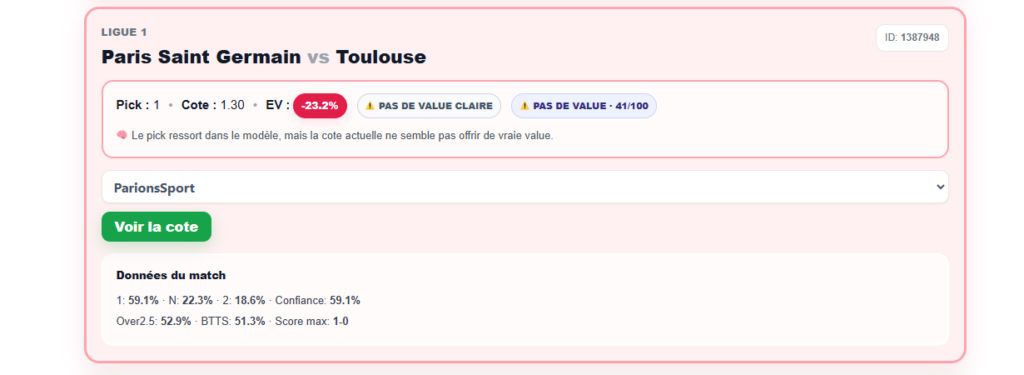
The red doesn't mean the pick is absurd or that PSG won't win. It simply means that at the current price, there's no clear value. The bet might be sound from a sporting perspective, but it's not attractive from a profit standpoint. This is a crucial difference, and it's precisely what the Premium page allows you to see immediately.
Conversely, when a match presents a genuine opportunity, the display turns green, as seen in the Ligue 2 match between Annecy and Guingamp. This means that the probability estimated by the model is higher than what the bookmaker's odds suggest. In this case, there is a value bet, meaning a bet that is potentially profitable in the long run. Green thus allows for the visual identification of the most interesting opportunities, while red signals matches to avoid or bet on with caution despite an apparent favorite.
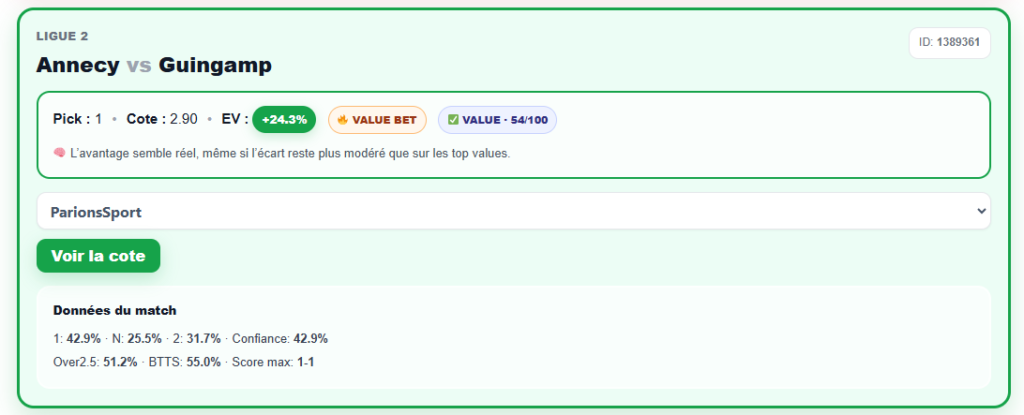
This visual logic makes reading the page much simpler. In just a few seconds, it becomes possible to understand whether a match is backed by genuine value or if it's simply a model pick without a clear price advantage. This is particularly useful for avoiding the common mistake of confusing a "likely bet" with a "profitable bet."
The strength of the Premium page lies precisely in putting the odds back at the heart of the analysis. Many bettors choose a team because it seems the strongest or most likely to win. But a strong favorite isn't always a good bet. If the odds are too low, the potential return no longer sufficiently compensates for the risk. In the long run, these details are what make the difference between an intuitive approach and a truly well-structured one.
Each match displayed on the Premium page provides a comprehensive overview. The recommended pick, odds, expected value (EV), model confidence, 1-X-2 probabilities, markets like Over 2.5 or BTTS, and the most likely score are all there to give you a clear framework for decision-making. The goal isn't to play every match, but to better understand which ones truly deserve your attention.
Using the example of PSG versus Toulouse, we can clearly understand how the page works. The model correctly predicts Paris will win, but the odds don't offer a viable advantage. The red color indicates this lack of value. When a more favorable spot is identified, green will appear to highlight a more attractive opportunity.
Footprobability's Premium page doesn't try to make you believe that all favorites are betable. On the contrary, it aims to show when a pick is supported by the odds, and when it isn't. This more rigorous, visual, and honest analysis allows you to approach betting with a more methodical approach.
Play like FootProbability